
Eusebio
-
Posts
17 -
Joined
-
Last visited
Recent Profile Visitors
461 profile views
Eusebio's Achievements

Seeker (1/7)
0
Reputation
-
Func _BDConnect($bdName="",$Server="",$mode=3,$connectionTimeOut=0,$commandTimeOut=0) ;Cadenas de conexión: http://www.connectionstrings.com/ Local $xCNN,$cConn if $Server="" Then if StringUpper(StringRight ($bdName,4))<>".MDB" Then $bdName=$bdName & ".MDB" EndIf $cConn="PROVIDER=MICROSOFT.JET.OLEDB.4.0;DATA SOURCE=" & $bdName Else $cConn="Provider=sqloledb;Server=" & $Server & ";Initial Catalog=" & $bdName & ";integrated security=SSPI;persist security info=False;" ;$cConn="Driver={SQL Server};Server=" & $Server & ";Database=" & $bdName & ";Trusted_Connection=Yes;" ;$cConn="Driver={SQL Server};Server=" & $Server & "Database=" & $bdName & ";Uid=sa;Pwd=MyPassword;" ;$cConn="Provider=sqloledb;Data Source=192.168.1.10,1433;Network Library=DBMSSOCN;Initial Catalog=" & $bdName & ";User ID=sa;Password=MyPassword;" ;$cConn="Data Source=" & $Server & ";Initial Catalog=" & $bdName & ";Integrated Security=SSPI;" EndIf $xCNN=Objcreate("ADODB.Connection") $xCNN.mode=$mode ;(2=adModeRead; 3=adModeReadWrite; 12=adModeShareExcludive) $xCNN.connectiontimeout=$connectionTimeOut $xCNN.commandtimeout=$commandTimeOut $xCNN.Open($cConn) Return $xCNN EndFunc Func _BDCloseConnexion(ByRef $xCNN) ;State ; adStateClosed =0 ; adStateOpen =1 ; adStateConnecting=2 if $xCNN.state=1 then $xCNN.close $xCNN=0 EndIf EndFunc Func _BDCloseRecordSet(byref $RS) ;State ; adStateClosed =0 ; adStateOpen =1 ; adStateConnecting=2 if $RS.state=1 then $RS.close $RS=0 EndIf EndFunc Func _BDSQLQuery(ByRef $xCNN,$strSQL,$cursorLocation=3,$cursorType=3,$lockType=3) ;CursorLocation ; adUseServer =2 ; adUseClient =3 ;CursorType ; adOpenForwardOnly =0 ; adOpenKeyset =1 ; adOpenDynamic =2 ; adOpenStatic =3 ;LockType ; adLockReadOnly =1 ; adLockPessimistic =2 ; adLockOptimistic =3 ; adLockBatchOptimistic=4 Local $miRS $miRS=ObjCreate("ADODB.Recordset") $miRS.cursorLocation=$cursorLocation $miRS.cursortype=$cursorType $miRS.locktype=$lockType $miRS.activeconnection=$xCNN $miRS.source=$strSQL $miRS.open Return ($miRS) EndFunc Func _getTables(ByRef $xCNN) Local $adoRs,$cCad $cCad="" $adoRs=Objcreate("ADODB.Recordset") $adoRs = $xCNN.OpenSchema (20) while not $adoRs.eof() if stringmid($adoRs("TABLE_NAME").value,1,4)<>"MSys" Then $cCad=$cCad & $adoRs("TABLE_NAME").value & "|" EndIf $adoRs.movenext() wend $adoRs.close() $adoRs=0 Return $cCad EndFunc Func _BDQuote($str) Return (Quote = "'" & $str & "'") EndFunc
-
This is for Windows Vista.
-
I think this is a backup of this forum and are not all answers. But, thanks a lot to who answer to me. Yes, I resolved the problem like this: IE -> Tools / Internet Options / Security -> Disable IE protected mode Thanks, Eusebio.
-
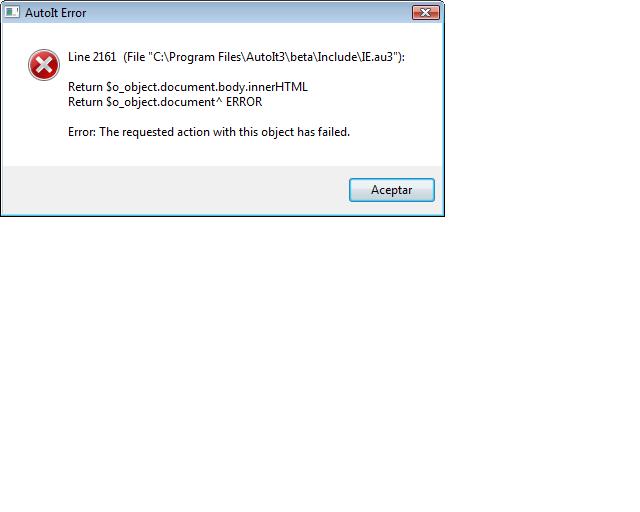
An error with IE.au3 in Windows Vista AutoIt Error: Line 2161 (File "C:\Program Files\AutoIt3\beta\IE.au3"); Return $o_object.document.body.innerHTML Return $o_object.document^ERROR Error: The requested action with this object has failed.
-
Here my old code in au3: http://www.autoitscript.com/forum/index.ph...st&p=224962
-
Get information from WhoIs servers and get domains information. For example, put in the programme: cocacola.com You can put more servers (specialy for other country domains) from: http://www.iana.org/root-whois/index.html and complet whois.ini BR, Eusebio. WhoIs.zip
-
If you are interested, I Know how now: TCPStartUp() dim $datos="" $ip=TCPNameToIP ("whois.nic.fr") while 1 $socket = TCPConnect($ip, 43 ) If $socket = -1 Then MsgBox(1,@error,"No conectado") Else ExitLoop EndIf WEnd TCPSend ( $socket,"123pizza.fr" & @CRLF ) If @error Then MsgBox(1,@error,"Error al enviar los datos") EndIf While 1 $recv = TCPRecv( $Socket, 2048 ) If @error Then ExitLoop If $recv <> "" Then $datos=$datos & $recv EndIf WEnd ConsoleWrite($datos) TCPShutdown ( )
-
Anyboyd knows the way to connect to WhoIs server with sockets? I know the port is 43 but I don't know how to connect and save the data. Thanks, Eusebio.
-
Hi Paulie, You must put ".flv" extension to the download file. Then you can view the video with a flv player or use another tool for convert the file to other format like: avi,mpg... I use "cinemaforge 2.0" you can download it from this link: http://www.download.com/CinemaForge/3000-2...4-10496506.html Eusebio.
-
Fantastic GUI (with download progress). Thanks for rewrite and do better the code (only with inet). Now is perfect. Eusebio.
-
Yes, of course.. There are many ways to download from youtube, but this is in autoIt and you can look how work the other tools...
-
In this page you can do the same: http://javimoya.com/blog/youtube.php Eusebio.
-
The download file must be renamed to extension .flv and then you can see the video with flv viewer or convert to other formats (avi,mpg) with your prefered tools. #include <INet.au3> #include <IE.au3> Local $sYouTubeLink="http://www.youtube.com/watch?v=lv4Potdpjhw" Local $oIE $sYouTubeLink=InputBox("Download YouTube videos","YouTube link:", $sYouTubeLink) if stringlen($sYouTubeLink)=0 Then Exit EndIf $sCode=_INetGetSource ($sYouTubeLink) $s_t=StringRegExp($sCode, "&t=(.*?)&", 3) $s_v=stringmid($sYouTubeLink,stringinstr($sYouTubeLink,"v=")+2) $sDownloadLink="http://youtube.com/get_video?video_id=" & $s_v & "&t=" & $s_t[0] $oIE=_IECreate ($sDownloadlink,0, 0, 1)The code could be better, you can change and post here. I would like detect when cancel download button is pressed for abort/exit script.
-
Soundex and levenstein distance algorithms
Eusebio replied to Eusebio's topic in AutoIt General Help and Support
I've created functions if anybody are interested (any comments are welcome) ;.......................................................................................................................................... ; This function returns an integer number which indicates the Levenshtein-Distance between the two ; argument strings or -1, if one of the argument strings is longer than the limit of 255 characters ; (255 should be more than enough for name or dictionary comparison). ; ; The Levenshtein distance is defined as the minimal number of characters you have to replace, ; insert or delete to transform sString1 into sString2. ; ; The greater the Levenshtein-Distance, the more different the strings are. ; Levenshtein-Distance is named after the Russian scientist Vladimir Levenshtein, ; who devised the algorithm in 1965. ; In its simplest form the function will take only the two strings as parameter and will calculate ; just the number of insert, replace and delete operations needed to transform sString1 into sString2. ; ; If you can't spell or pronounce Levenshtein, the metric is also sometimes called 'edit distance'. ; The Levenshtein distance algorithm has been used in: ; - Spell checking, - Speech recognition, - DNA analysis, - Plagiarism detection . ; ; Reference: [url=http://www.merriampark.com/ld.htm]http://www.merriampark.com/ld.htm[/url] ; ; I added some character 'cleaning' procedures prior to the specific Levenshtein algorithm. ; ; Eusebio Pérez Hurtado ;.......................................................................................................................................... Func _Levenshtein ($sString1, $sString2) $iStrLen1 = StringLen($sString1) $iStrLen2 = StringLen($sString2) If $iStrLen1=0 Then Return ($iStrLen2) EndIf If $iStrLen2=0 Then Return ($iStrLen1) EndIf If ($iStrLen1>255) Then Return (-1) ; see Note at end of function. If ($iStrLen2>255) Then Return (-1) ; see Note at end of function. ;.......................................................................................................................................... ; Cleanup procedures, not quite necessary, but useful. $sString1 = StringUpper($sString1) $sString1 = _StringClean($sString1,"ÄÅÃÂÁÀ","A") $sString1 = _StringClean($sString1,"ËÊÉÈ" ,"E") $sString1 = _StringClean($sString1,"ÏÎÍÌ" ,"I") $sString1 = _StringClean($sString1,"ÒÓÔÕÖ" ,"O") $sString1 = _StringClean($sString1,"ÜÛÚÙ" ,"U") $sString1 = _StringClean($sString1,"Ç","C") $sString1 = _StringClean($sString1,"Ñ","N") $sString2 = StringUpper($sString2) $sString2 = _StringClean($sString2,"ÄÅÃÂÁÀ","A") $sString2 = _StringClean($sString2,"ËÊÉÈ" ,"E") $sString2 = _StringClean($sString2,"ÏÎÍÌ" ,"I") $sString2 = _StringClean($sString2,"ÒÓÔÕÖ" ,"O") $sString2 = _StringClean($sString2,"ÜÛÚÙ" ,"U") $sString2 = _StringClean($sString2,"Ç","C") $sString2 = _StringClean($sString2,"Ñ","N") $sString1 = _StringClean($sString1,"ABCDEFGHIJKLMNOPQRSTUVWXYZ","",2) ;OjO! aquí quito los numeros también $sString2 = _StringClean($sString2,"ABCDEFGHIJKLMNOPQRSTUVWXYZ","",2) ;OjO! aquí quito los numeros también ;.......................................................................................................................................... ; The Levenshtein algorithm $iStrLen1 = StringLen($sString1) $iStrLen2 = StringLen($sString2) Dim $aArray [$iStrLen1+1][$iStrLen2+1] For $iRow=0 To $iStrLen1 $aArray[$iRow][0] = $iRow Next For $iCol=0 To $iStrLen2 $aArray[0][$iCol] = $iCol Next For $iRow=1 To $iStrLen1 For $iCol=1 To $iStrLen2 $iCost = StringMid($sString1,$iRow,1) <> Stringmid($sString2,$iCol,1) $iRowPrev = $iRow-1 $iColPrev = $iCol-1 $aArray[$iRow][$iCol] = _Min3(1+$aArray[$iRowPrev][$iCol],1+$aArray[$iRow][$iColPrev],$iCost+$aArray[$iRowPrev][$iColPrev]) Next Next $iDistance = $aArray[$iStrLen1][$iStrLen2] Return ($iDistance) EndFunc oÝ÷ Ù«¢+Ø)Õ¹}5¥¸Ì ÀÌØí¸Ä°ÀÌØí¸È°ÀÌØí¸Ì¤(íIÑÕɹÌÑ¡5¥¹¥µÕ´½Ì¹ÕµÉÌ(íÕÍ¥¼AÉè!ÕÉѼ(ÀÌØíµ¥¸ÌôÀÌØí¸Ä(%ÀÌØí¸È±ÐìÀÌØíµ¥¸ÌQ¡¸ÀÌØíµ¥¸ÌôÀÌØí¸È(%ÀÌØí¸Ì±ÐìÀÌØíµ¥¸ÌQ¡¸ÀÌØíµ¥¸ÌôÀÌØí¸Ì(%IÑÕɸ ÀÌØíµ¥¸Ì¤)¹Õ¹oÝ÷ Ù«¢+Ø(츸¸¸¸¸¸¸¸¸¸¸¸¸¸¸¸¸¸¸¸¸¸¸¸¸¸¸¸¸¸¸¸¸¸¸¸¸¸¸¸¸¸¸¸¸¸¸¸¸¸¸¸¸¸¸¸¸¸¸¸¸¸¸¸¸¸¸¸¸¸¸¸¸¸¸¸¸¸¸¸¸¸¸¸¸¸¸¸¸¸¸¸¸¸¸¸¸¸¸¸¸¸¸¸¸¸¸¸¸¸¸¸¸¸¸¸¸¸¸¸¸¸¸¸¸¸¸¸¸¸¸¸¸¸¸¸¸(ìM½Õ¹àµ¹¥Áձѥ½¸Í½¸(ìT¹L¸AѹÑÌÄÈØÄÄØÜ ÄäÄरÄÐÌÔØØÌ ÄäÈȤ(ìä5ÉÉÐ,¸=±°¹I½ÉиIÕÍÍ°(ìÌÕÍäÑ¡9Ñ¥½¹°É¡¥Ù̹I½É̵¥¹¥ÍÑÉÑ¥½¸¡9I¤(ì¡ÁÕ±¥Í¡ä½¸-¹ÕÑ m-¹ÕÑ¡t¤¸(ì(ìIÕÍÍ°Ìäí̵ѡ½¥ÌÕͱ½È¹µÌɽ´¹±¹°µÉ¥°ÝÍÑɸÕɽÁ½Õ¹Ñɥ̰(ìÕн̹½ÐÁÁ±äݱ°Ñ¼µ¹äM±Ù¥¹e¥¥Í ÍÕɹµÌ(칥̹½Ð¥¹Á¹¹Ð½ÍÙÉ°Ñ¡¹¥½¹Í¥ÉÑ¥½¹Ì¸(ì(ì]¥Ñ ͽչà°Ñ¡ÅÕ½ÐíͽչÅÕ½Ðì½¹µÌ´Ñ¡Á¡½¹Ñ¥Í½Õ¹Ñ¼áа¥Ì½¸(ìQ¡¥Ì¥Ì½ÉС±ÀÍ¥¹¥ÐÙ½¥Ìµ½ÍÐÁɽ±µÌ½µ¥ÍÍÁ±±¥¹Ì½È±ÑɹÑÍÁ±±¥¹Ì¸(ì½ÈáµÁ±M¡Éµ¸°M¡Õɵ¸°M¡Éµ¸¹M¡¥Éµ¸¹M¡Õɵ¸É¥¹áѽѡÈÌÅÕ½ÐíLØÔÔÅÕ½Ðì¸(ìMÕɹµÍ½Õ¹à¥¹á¥¹¥Ì¹½Ð±Á¡Ñ¥°°ÕХ̱¥ÍÑäÑ¡±ÑÑȵ¹µ¹ÕµÈ½¸(ì%ÍÙÉ°ÍÕɹµÌ¡Ùѡ͵½°Ñ¡¥ÈÉÌÉÉɹ±Á¡Ñ¥±±ää¥Ù¸¹µ¸(ìáµÁ±èLØÔÔÉÑ¡ÕÈ°LØÔÔ ÑÍä°LØÔÔ ¡É±Ì¸(ì(ìIÕÍͱ°M½Õ¹à9µµ5Ñ¡¥¹(ìQ¡IÕÍͱ°M½Õ¹à ½±½É¥Ñ¡´¥ÌÍ¥¹ÁÉ¥µÉ¥±ä½ÈÕÍÝ¥Ñ ¹±¥Í ¹µÌ¹¥Ì(ìÁ¡½¹Ñ¥±±ä͹µµÑ¡¥¹µÑ¡½¸Q¡±½É¥Ñ¡´½¹ÙÉÑÌ ¹µÑ¼½Õȵ¡ÉÑȽ°(ìÝ¡¥ ¸ÕÍѼ¥¹Ñ¥äÅÕ¥Ù±¹Ð¹µÌ°¹¥ÌÍÑÉÕÑÕÉ̽±±½ÝÌm-¹ÕÑ¡tè(ìĸIÑ¥¸Ñ¡¥ÉÍбÑÑȽѡ¹µ°¹É½À±°½ÕÉɹ̽°° °¤°¼°Ô°Ü°ä¥¸½Ñ¡ÈÁ½Í¥Ñ¥½¹Ì¸(ìȸÍÍ¥¸Ñ¡½±±½Ý¥¹¹ÕµÉÌѼѡɵ¥¹¥¹±ÑÑÉÌÑÈÑ¡¥ÉÍÐè(ì°°À°ØôôÄ(ì°°¨°¬°Ä°Ì°à°èôôÈ(ì°ÐôôÌ(ì°ôôÐ(ì´°¸ôôÔ(ìÈôôØ(ì̸%Ñݼ½Èµ½É±ÑÑÉÌÝ¥Ñ Ñ¡Íµ½ÝÉ©¹Ð¥¸Ñ¡½É¥¥¹°¹µ¡½ÉÍÑÀĤ ÌÌìÌÌìÌÌ줰(ì½µ¥Ð±°ÕÐÑ¡¥ÉÍи(ìи ½¹ÙÉÐѼѡ½É´E±ÑÑÈ°¥¥Ð°¥¥Ð°¥¥ÒH䥹ÑÉ¥±¥¹éɽÌ(졥ѡÉɱÍÌÑ¡¸Ñ¡É¥¥Ñ̤°½ÈäɽÁÁ¥¹É¥¡Ñµ½ÍÐ¥¥ÑÌ¥ÐÑ¡Éɵ½ÉÑ¡¸Ñ¡É¸(ì(ì½ÈáµÁ±°Ñ¡¹µÌձȰÕÍÌ°!¥±Éа-¹ÕÑ ¹1±½åɥٸѡÉÍÁÑ¥Ù½Ì(ìÐØÀ°ÈÀÀ° ÐÄØ°,ÔÌÀ°0ÌÀÀ¸(ì!½ÝÙÈ°Ñ¡±½É¥Ñ¡´±Í¼¥ÙÌѡ͵½Ì½È(ì±±Éä°¡½Í °!¥±É½¹¸°-¹Ð¹1m-¹ÕÑ¡tÝ¡¥ ɹ½Ðɱѥ¸É±¥Ñä¸(ì(ìm-¹ÕÑ¡t踸-¹ÕÑ °Q¡ÉÐ= ½µÁÕÑÈAɽɵµ¥¹°Y½°¸Ì°M½ÉÑ¥¹¹MÉ¡¥¹°¥Í½¸]ͱä°ÁÀÌäÄ´Ìäȸ(ì(ìÕÍ¥¼AÉè!ÕÉѼ(츸¸¸¸¸¸¸¸¸¸¸¸¸¸¸¸¸¸¸¸¸¸¸¸¸¸¸¸¸¸¸¸¸¸¸¸¸¸¸¸¸¸¸¸¸¸¸¸¸¸¸¸¸¸¸¸¸¸¸¸¸¸¸¸¸¸¸¸¸¸¸¸¸¸¸¸¸¸¸¸¸¸¸¸¸¸¸¸¸¸¸¸¸¸¸¸¸¸¸¸¸¸¸¸¸¸¸¸¸¸¸¸¸¸¸¸¸¸¸¸¸¸¸¸¸¸¸¸¸¸¸¸¸¸¸¸¸)Õ¹}M½Õ¹à ÀÌØíÍMÑÉ¥¹¤(%%MÑÉ¥¹1¸ ÀÌØíÍMÑÉ¥¹¤ôÀQ¡¸($%IÑÕɸ ÅÕ½ÐìÅÕ½Ðì¤(%¹%($ÀÌØíÍMÑÉ¥¹ôMÑÉ¥¹UÁÁÈ ÀÌØíÍMÑÉ¥¹¤(($ìIÑ¥¸Ñ¡¥ÉÍбÑÑȽѡ¹µ¸($ÀÌØíÍ ¡É¥ÉÍÐôMÑÉ¥¹5¥ ÀÌØíÍMÑÉ¥¹°Ä°Ä¤(($ìÍÁ¥°ÁɵÁɽÍÍ¥¹½Èɵ¸±¹Õ($ÀÌØíÍMÑÉ¥¹ôMÑÉ¥¹IÁ± ÀÌØíÍMÑÉ¥¹°ÅÕ½ÐíM ÅÕ½Ðì°ÅÕ½ÐíLÅÕ½Ðì¤ìɵ¸ÍÁ¥°ÅÕ½ÐíÍ ÅÕ½Ðì($ÀÌØíÍMÑÉ¥¹ôMÑÉ¥¹IÁ± ÀÌØíÍMÑÉ¥¹°ÅÕ½Ðï|ÅÕ½Ðì°ÅÕ½ÐíLÅÕ½Ðì¤ìɵ¸ÍÁ¥°Í¡ÉÀµÌÅÕ½Ðï|ÅÕ½Ðì(($ìɽÀ±°½ÕÉɹ̽°° °$° -
I would like to use a function that is in this dll: xnm34i.dll This DLL is for winbatch script language. Is possible to use with DllCall in AutoIT? My code is: $sResult=DllCall ( "xnm34i.dll", "str","nmSoundex","str","TEST","int",0 ) the return error is 3: @error = 3 "function" not found in the DLL file Can you help me, please... Thanks, Eusebio