Search the Community
Showing results for tags 'nova'.
Found 1 result
-
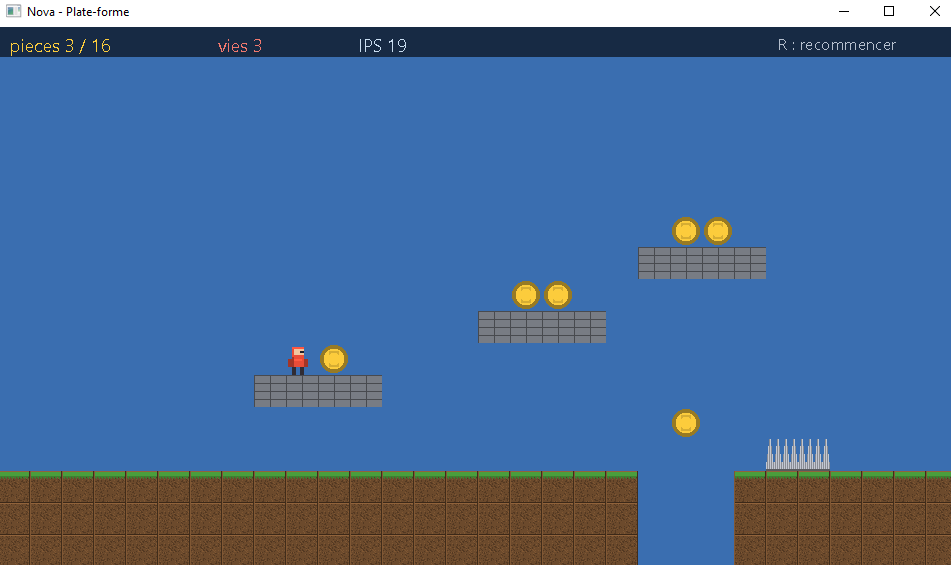
 What this is Nova is a 2D game engine for AutoIt 3.3.16.1. Rendering is Direct2D on a Direct3D 11 device, presented by DXGI, text by DirectWrite - reached through COM vtable addresses resolved at import time. No C runtime, no compiler, no DLL to build, no include beyond Nova.au3: you keep writing .au3. You write two functions. The engine owns the window, the device and the timing. Func Update($fDT) ; runs at a fixed 60 Hz $fVy += 1400 * $fDT $fY += $fVy * $fDT EndFunc Func Draw() ; once per frame, after the logic _Nova_FillRect(0, 400, 960, 140, _Nova_RGB(40, 44, 52)) _Nova_FillRect($fX, $fY, 32, 32, _Nova_RGB(255, 80, 40)) _Nova_TextUI("FPS " & Int(_Nova_FPS()), 8, 8) EndFunc _Nova_Create("My game", 960, 540) _Nova_Run("Update", "Draw") ; blocks until the window closes _Nova_Destroy() Four verbs - Create, Run, Quit, Destroy - are the whole lifecycle. What is in the box 139 public functions and about 9 650 lines of engine source, in these families: window + device, vsync, and a CPU rasteriser you can force if the GPU path is unavailable rectangles, lines, ellipses, circles, colours as 0xAARRGGBB images: load PNG, draw, draw a part of a sheet, scale, mirror, rotate, alpha text: DirectWrite for world space, one simpler UI call for HUDs tile maps: a level is a piece of text, one character per tile, only the visible tiles are drawn physics: AABB bodies with gravity, terminal velocity, ground snap, anti-tunnelling sub-steps, and a body that spins with its own angular acceleration, inertia and speed cap, slides with friction, and carries one free slot for whatever your game needs camera: absolute, or follow with smoothing and map clamping input: keyboard, mouse, wheel, XInput gamepad, plus an injection API so a run can be scripted particles, a named scene stack, seeded random, a flat key/value save file animations whose frames each have their own duration, and a debug overlay (box, velocity arrow, facing mark) you switch on for one body at a time sound: dsound.dll for .wav effects - volume, pitch and pan - and winmm/MCI for music, both shipped with Windows, and the .wav path falls back to MCI by itself on a machine that refuses DirectSound _Nova_Capture(): the engine hands you the pixels it computed as a PNG - not a screenshot of your desktop _Nova_LastError() explains any failure in a sentence; nothing fails silently Three games to open right now examples/01_hello.au3 - twenty lines: a window, a bouncing ball, a keyboard. examples/03_catch.au3 - the game the attached course builds, step by step: a character that walks a four-frame strip, fruit that falls, a catch that scores, three lives, three screens, particles and sound. examples/02_plateforme.au3 - a full platformer: 3 levels written as text, coins, spikes, camera, HUD, title / game / win-lose screens, keyboard and gamepad. It tests itself Every example and every test accepts /check: the game plays itself, captures its own frame, and exits with a return code. One command runs the whole proof, and its exit code is the number of failed steps: python tools/nova_suite.py --rapport 14 steps, 0 failures - on the 32-bit interpreter and on the 64-bit one the two interpreters write the same pixels: the diff of the two captures is 0 pixels out of 468 000 3 image locks compare a PNG against coordinates computed by hand (69 + 35 + 23 assertions), so a rendering regression is a failing test, not a screenshot nobody noticed 59 COM calls checked argument by argument against the ABI table, 210 unit assertions on the API contract /route replays the platformer's physics frame by frame and searches, for every platform, a jump frame that actually lands on it - a level asking for a jump the physics cannot give fails the run instead of shipping. It reports the measured apex (138 px), not the V^2/2G formula (144 px), because the integration is discrete and snaps to the pixel. The attached PDF is a course, not a changelog Nova-course.pdf, 23 A4 pages: nine steps, each one a program you can run, from an empty window to the complete catch game, then ten graded exercises, a "when it does not work" table and a glossary. It is generated from docs/course.md by tools/nova_pdf.py, and the build is gated: the listing in chapter 12 is examples/03_catch.au3 line for line, and every complete program printed in the course is compiled and kept alive for three seconds by the same suite. A course that drifts from the code it cites fails the build. What it does not do Being honest saves everybody a thread. No shaders, no blend modes beyond alpha, no post-processing. Isometric maps, pathfinding and animation state machines are yours to write; the engine stops at the primitives. Pitch and pan exist only on the DirectSound path, so a machine that refuses dsound.dll keeps its sounds (MCI takes them) and loses those two controls, which answer $NOVA_ERR_UNSUPPORTED. Format support on the MCI path is whatever your Windows has; WAV is what the tests exercise, MP3 is not forbidden, just not covered. A few hundred sprites per frame before the AutoIt interpreter, not the GPU, becomes the limit. 32-bit and 64-bit are both measured, but they are two builds: ship the interpreter you tested with. What makes that possible is that every Direct2D call in the engine passes its structures by address - the one form the two ABIs agree on. Sprite rotation is drawn as a rotated FillRectangle for that reason, so a segment and a turned bitmap paint the same on both. Getting started Unzip Nova-1.0.zip keep the folder layout, and either include the umbrella file or double-click an example: #include "Nova.au3" MANIFEST.md says which of the six shipped files are indispensable and which folders only exist for the demo. docs/quick_start.md is the ninety-second version, docs/api.md lists all 139 functions with their error codes, and docs/technique.md (French) holds the measurements behind every rule. Requirements: AutoIt 3.3.16.1 (either AutoIt3.exe or AutoIt3_x64.exe) and Windows 10 or 11. Licence MIT. Feedback, bug reports and "this API is awkward because..." are welcome. If you file a bug, run the suite first - it usually tells you whether the engine or your game is guilty.